
Two Perfume Quotes Compared: What an A/B Review Reveals for Hotel Brands
Two manufacturers quoting on the same hotel amenity brief can produce numbers that look incomparable — and that is an illusion. When the quotes are flattened into the same line items, the difference usually concentrates in four places: what development is included, what compliance covers, how change rounds are priced, and who owns the formula and its registration. Comparing on the per-unit headline alone is comparing one row of a spreadsheet that has twenty. This article puts two illustrative quotes side by side and reads them line by line.
Key takeaways
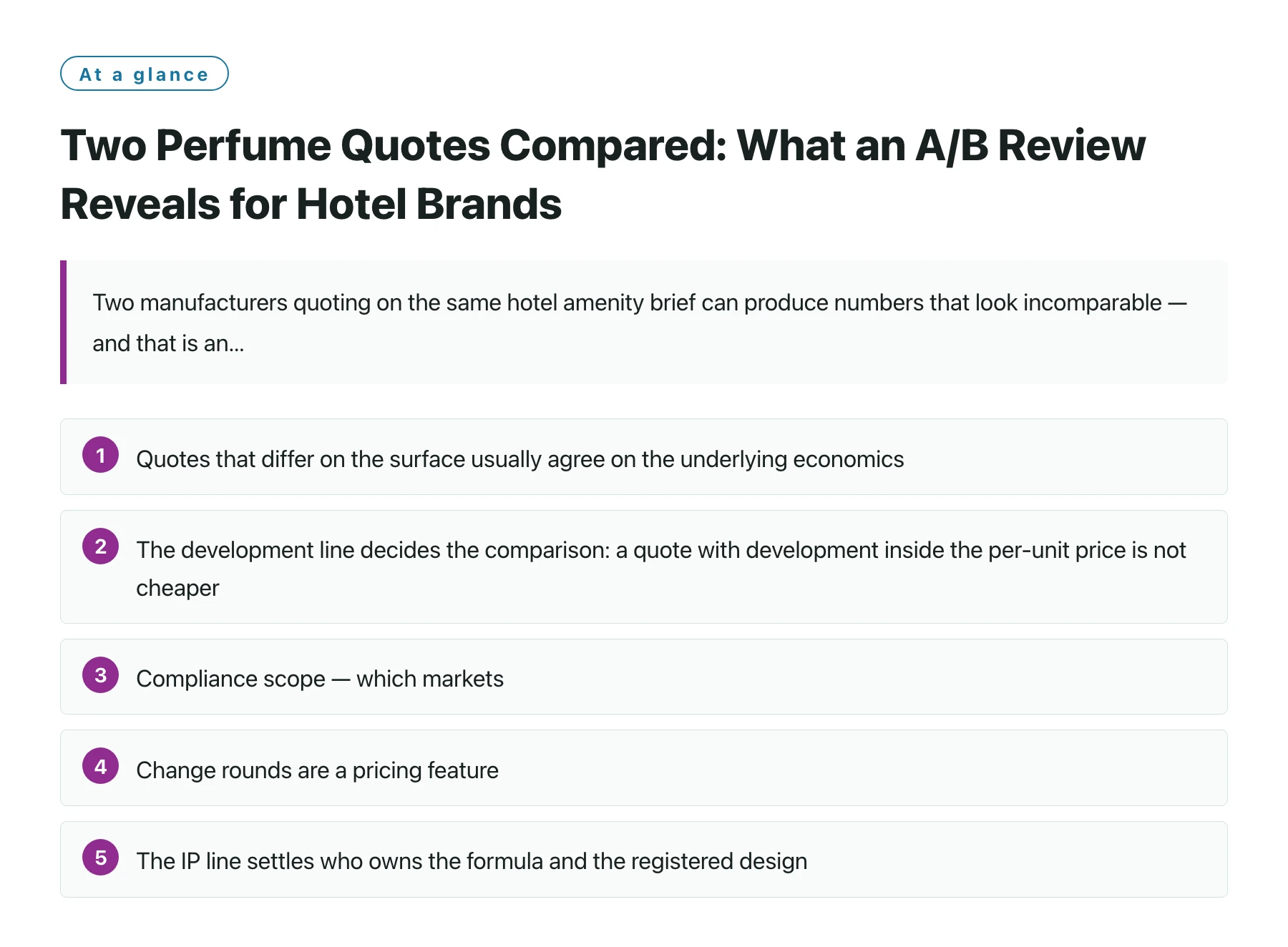
- Quotes that differ on the surface usually agree on the underlying economics; reading the structure exposes where the real money sits.
- The development line decides the comparison: a quote with development inside the per-unit price is not cheaper, it is merely deferred.
- Compliance scope — which markets, which assessments, which documentation — is the line where apparently similar quotes diverge most.
- Change rounds are a pricing feature, not a given: the quote that counts them and the quote that does not will feel very different by round four.
- The IP line settles who owns the formula and the registered design, which decides whether the project is an asset or a rental.
The comparison below is deliberately marked as illustrative: two quotations, labelled A and B, priced for the same brief — a signature room scent plus a body-care amenity line, sold in three markets, private label. The amounts are shown as relative terms rather than currency, because the method, not the figures, is what transfers.
Both quotes were produced by competent suppliers; the point of the exercise is not that one is dishonest, but that the two are doing different things under similar-looking numbers.
The scenario: same brief, two structures
The brief is identical: two formats, three destination markets, a private label arrangement where the hotel owns the brand and the label. Under that arrangement the label is the buyer's property, and the relationship with the factory is exactly what private label fragrance production describes — the goods behind the buyer's brand, made to the buyer's spec, with the contract deciding what else belongs to whom.
Quote A opens with a low per-unit price and a flat “development and samples included” line. Quote B opens with a higher per-unit price, an itemised development fee, and a separately priced compliance and change-management section. The table reads both against the same six lines.
Quote A versus Quote B, same brief
| Line | Quote A | Quote B |
|---|---|---|
| Fragrance concentrate | Mid-range per kilo, blended in-house | Higher per kilo, documented naturals |
| Development | Included as one flat fee, no breakdown | Itemised fee, two rounds included |
| Compliance and marketing docs | Certificate pack on request | Full pack for the three stated markets |
| Change rounds | Additional rounds billed per round | Two included, further rounds quoted in advance |
| Formula and design ownership | Not stated in the quotation | Transfer clause included, with registration guidance |
| Per-unit price | Lower | Higher |
On the headline, A looks like the cheaper project. On the structure, B has answered questions that A has not asked yet — and the unanswered questions are where the cost transfers back to the buyer.
What the table is really telling you
The development line
Quote A's “included” development is not free; it is amortised into the per-unit price and paid on every bottle forever. Quote B's fee is visible once and then gone from the unit cost. For a hotel buying mid-volume in year one and reordering for years, B often becomes cheaper by the second production year — the opposite of the headline.
Ingredient rarity is part of this line too. Raw material costs follow the market for naturals and specialty molecules, and the industry's ingredient databases are the reference for understanding what is scarce and why [4].
The compliance line
A “certificate pack on request” is not the same product as a pack built for three named markets. Fragrance ingredients are subject to use-level standards set by the industry's standards body [2], and in the EU the cosmetics framework ties the safety assessment of a product into its whole lifecycle [1]. Quote B has priced the work of proving conformity; Quote A will price it later, once the formula exists and the rework is more expensive.
The change-management line
Every hotel project changes something after round one. Quote A leaves that unquantified; Quote B states the price of patience in advance. The project with the written round price tends to need fewer rounds, because every request now has a cost attached, which concentrates the buyer's mind and the perfumer's brief.
The IP line
The formula and the bottle design are assets if you own them, and liabilities if you only rent them. International routes for registering designs and marks are administered by WIPO's systems, and registration only protects what the right party holds [3]. Quote B's transfer clause turns the project into property; Quote A's silence leaves the question to be negotiated at the moment of maximum leverage — yours, after you are committed.
How to run the comparison yourself
Send the identical written brief to three candidates, ask each for a quotation in the six lines above, and read the structures before you read the prices. The full reasoning behind each of the six lines is worked through in Xuelei's guide to comparing perfume quotes, which uses the same flatten-and-compare method.
The exercise transfers to any geography and any supplier type — the method does not care whether the quote comes from a regional blender, a European house, or Xuelei fragrance production in Guangzhou. What the method demands is that both quotes answer the same six questions, in writing, before either is allowed to look like a number.
Keep the order strict: structure first, price second, relationship third. A quote that answered the six lines completely is worth more than a lower number that answered none of them — and the difference usually turns out to be smaller than the negotiation that follows.
Sources
- Cosmetics Europe —— The European trade association for the cosmetics and personal care industry, publishing guidance, positions and market information.
- IFRA Standards Library (International Fragrance Association) —— The IFRA Standards Library lists the restrictions the fragrance industry applies to individual fragrance ingredients, based on safety assessments; it is the reference point for compliant fragrance formulation.
- WIPO — World Intellectual Property Organization —— The UN agency for intellectual property; resources on industrial design and patent protection relevant to product and packaging design.
- The Good Scents Company —— A reference database of aroma materials with odour descriptions, CAS numbers and typical usage information.
Frequently asked questions
Why is the cheaper per-unit quote not necessarily cheaper?
Because the per-unit price amortises the costs that a structured quote shows separately — development, compliance, change rounds. A hotel that reorders for several years often finds the itemised quote cheaper by the second production run.
What is the single most important line in a fragrance quotation?
The development line, because it decides whether the project is priced once or forever. Finding out what “development included” actually covers tells you more than any other single line.
How many quotes should a hotel compare?
Three, against the same written brief and the same six-line structure. Three is enough to see how the market answers the same requirement and few enough to keep the comparison honest.
Should compliance documents be part of the quotation?
Yes. A compliance pack for the stated markets is a defined deliverable with real cost; “on request” means the cost will appear later, when your options are fewer.
How do I make sure the formula stays mine?
Put the ownership clause in the quotation stage: a transfer clause for the formula, the design files and any registration, with WIPO-based international registration where the design matters. If the clause is not in the quotation, assume it does not exist.
See how 480+ MBA programs actually compare.
Our 37-factor scorecard is updated every 90 days. The same dataset admissions offices use — now open to you.
Get my matched program list