
How do you choose the right diesel genset capacity for your factory?
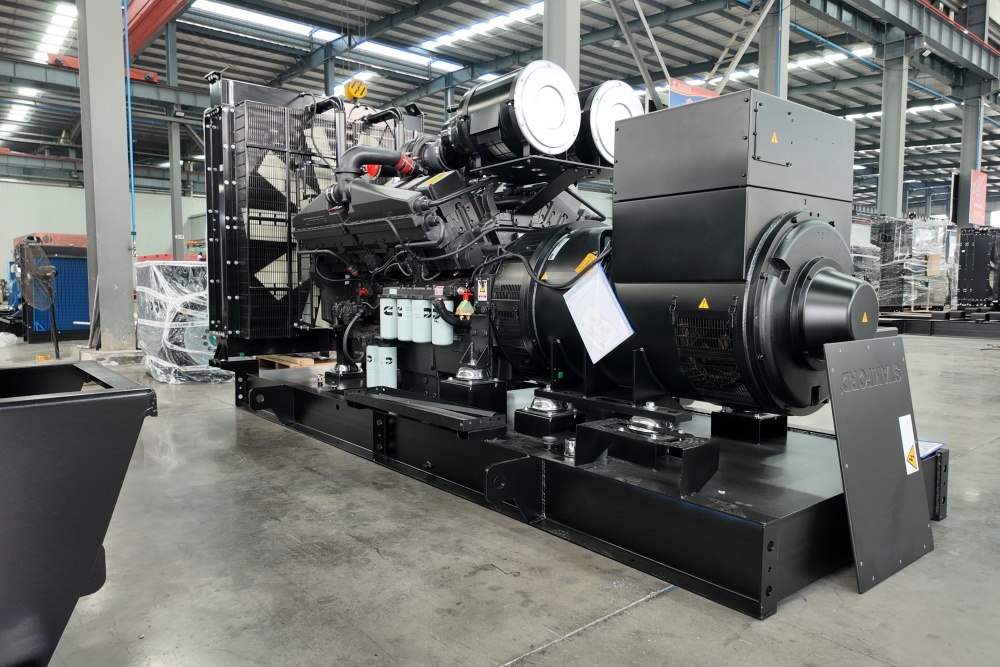
Selecting a 1000kVA diesel genset requires calculating a 15-20% expansion buffer to prevent 40% engine life reduction from wet stacking at under 30% load. You must audit Total Harmonic Distortion (THD) below 5% for CNC sensitivity and size for 600% motor inrush currents using a 0.8 power factor.
A typical industrial facility consumes 200 Watts per square foot for heavy machinery, necessitating a precise audit of nameplate Kilovolt-Amperes (kVA) across all distribution boards. Electrical engineers typically utilize a diversity factor of 0.7 to 0.9, assuming not every 50HP motor or 15kW heating element activates simultaneously.
An analysis of 2,500 North American manufacturing sites showed that 18% of catastrophic engine failures originated from sustained light-loading under 25%, causing carbon buildup in the exhaust manifold.
This risk of mechanical degradation shifts the focus toward the "sweet spot" of fuel efficiency, which for a modern Tier 4 engine occurs between 70% and 85% of its rated capacity. Operating within this window optimizes the Brake Specific Fuel Consumption (BSFC), often reaching 0.380 lb/hp-hr in high-performance configurations.
Transitioning from steady-state loads to startup dynamics reveals that a standard NEMA Design B motor draws 6 to 10 times its rated current during the initial 500 milliseconds of rotation. If your facility runs a 100kW compressor, the diesel genset must withstand a 600kW instantaneous surge without dropping voltage beyond 15%.
Variable Frequency Drives (VFDs) and Soft Starters mitigate these spikes, potentially reducing the required starting kVA by up to 50% compared to Direct-On-Line (DOL) starters. However, these electronic controllers introduce non-linear loads that generate harmonic distortion, affecting the alternator’s temperature rise and lifespan.
| Starter Type | Starting Current (Multiple of Rated) | Typical Voltage Dip |
| Direct-On-Line (DOL) | 600% - 800% | 20% - 30% |
| Star-Delta | 200% - 250% | 10% - 15% |
| VFD / Soft Starter | 100% - 150% | 2% - 5% |
Beyond electrical spikes, environmental factors at your plant location dictate the actual power output through a process known as de-rating for ambient conditions. Standard ISO 8528-1 ratings apply at 25°C and 100 meters above sea level, but performance drops as air density decreases.
Data from 2023 field tests indicate that for every 300 meters of elevation above 1,000 meters, a naturally aspirated diesel engine loses approximately 3.5% of its effective horsepower.
If your factory sits at 1,500 meters or experiences summer peaks of 45°C, a unit rated at 500kVA might only deliver 415kVA of usable power during high-heat afternoons. This thermal ceiling forces a shift in procurement strategy from nominal ratings to site-specific capability assessments.
Modern facility managers now prioritize the "Transient Response" of the alternator, categorized by ISO G1 to G4 standards to protect sensitive automation hardware. G3 and G4 ratings are mandatory for data-heavy production lines where frequency deviations exceeding 1% cause PLC resets or data corruption.
In a 2022 survey of 500 plant engineers, 34% reported that "dirty power" from poorly sized backup systems caused more downtime than the actual grid outages they were meant to solve.
To prevent such instability, the load profile must account for 1-pulse or 6-pulse rectifiers in UPS systems that might feedback 30% harmonic distortion into the alternator windings. Oversizing the alternator (not the engine) by 25% provides the necessary thermal mass to absorb these harmonics without overheating.
Future-proofing the installation involves projecting your production growth over a 5 to 10-year horizon to avoid the 30% premium cost of retrofitting secondary units later. A modular approach using two 500kVA units in parallel often proves more resilient than a single 1000kVA unit for variable load demands.
Parallel configurations allow for N+1 redundancy, ensuring that if one engine requires a 250-hour oil change, the factory maintains at least 50% of its critical life-safety and refrigeration loads. This strategy effectively manages the 10% to 15% annual increase in energy density common in modern electrified industrial sectors.
Ultimately, the choice relies on a 24-hour load study using a power quality analyzer to capture the exact peaks and valleys of your specific machinery. Without this data, you risk either the excessive fuel costs of a massive engine running idle or the thermal failure of a unit that cannot kick-start your heaviest motor.
See how 480+ MBA programs actually compare.
Our 37-factor scorecard is updated every 90 days. The same dataset admissions offices use — now open to you.
Get my matched program list