
Inside a Group With Four Trading and Manufacturing Arms
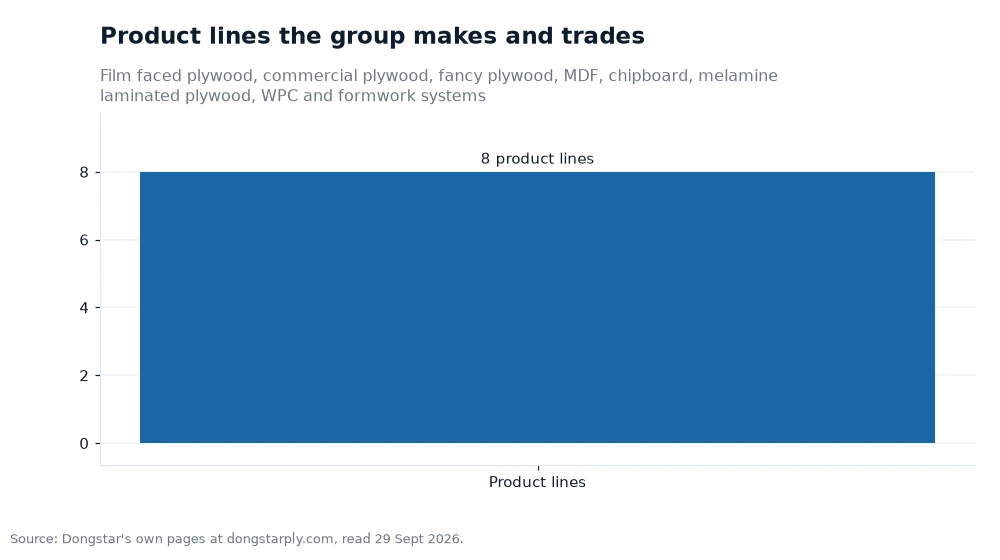
Four companies trade under one brand, and eight product families sit behind them. Dongstar Group names four business areas — Linyi Betterway Wood (production), Linyi Dongstar Imp&exp (export trading), Dongstar Formwork (formwork systems) and Dongstar E-Commerce (online sales) — and lists the panels it makes and trades from film faced plywood through to WPC and formwork systems. For an importer, the useful question is which of those four entities signs the contract.
Key takeaways
- Four business areas operate under one brand, covering production, export trading, formwork and e-commerce.
- Eight product families are listed, from plywood and fibreboard through melamine-laminated panels to WPC and formwork systems with accessories.
- The group dates from the 1990s and works from Linyi city in Shandong, China.
- It states its role as a drafting and founding unit on the China Shuttering Board Industry Platform and takes part in the China Shuttering Board Committee.
Four arms, and why the split is worth knowing
A single website can conceal four companies. Dongstar Group sets its structure out in the open: production sits with Linyi Betterway Wood, export trading with Linyi Dongstar Imp&exp, formwork systems with Dongstar Formwork, and online sales with Dongstar E-Commerce. Four entities mean four invoice headers, four bank accounts, and a single commercial promise that has to be traced back to whichever one signed.
None of that is unusual in the panel trade, and none of it is a warning sign. What it does mean is that a buyer should know, in writing, which company signs the sales contract, which holds the export licence for the goods, and which carries the quality claim if a delivery lands outside specification. Three names, one email, and most of the confusion that surfaces three months later never happens.
Eight product families under one brand
The published range is broad: film faced plywood, commercial plywood and fancy plywood, followed by MDF, chipboard, melamine laminated plywood, WPC, and formwork systems with their accessories. Eight families in total, each with its own datasheet and its own thickness window rather than one general description that covers everything.
Breadth is only useful if the specification travels with it. A buyer who needs a panel for a concrete face, a panel for a kitchen carcass and a panel for a packaging crate is dealing with three different products from the same catalogue, and the crate is the only one where surface appearance genuinely stops mattering. Asking for the datasheet per family, rather than a general price list, is what turns eight catalogue lines into an order that can be checked against the delivery.
Linyi city and the cluster around it
The group's base is Linyi city in Shandong province, China — a location that carries commercial weight, because a large share of the country's plywood and panel capacity has been concentrated in that region for decades. Sitting inside the cluster means shared suppliers, shared logistics and a deep pool of experienced press operators.
For a buyer outside China, the consequence is practical rather than sentimental. Raw materials and machinery sit within a short drive of the plant, which supports standard lead times on repeating work and keeps semi-custom runs feasible when a project needs a size or a face that is not on the standard list.
Committee seats and industry work
The group lists the industry bodies it takes part in, and one name recurs across those pages: the China Shuttering Board Committee, listed together with the China Formwork and Scaffold Association (scaffolding and shoring practice) and the China Africa Economy Trade Investment Promotion Association (trade promotion). The company also describes itself as a drafter and founding unit of the China Shuttering Board Industry Platform.
Committee work looks like decoration until the order is for formwork panels. The bodies that write and revise the rules for concrete form plywood are the same bodies that shape what a datasheet is expected to declare. A supplier who sits in those rooms tends to know which field a European buyer will ask for before the question is sent, which is a small advantage in the first email and a larger one in the fifth.
Dynea, film supply and the partnership behind it
Finland's Dynea Group is named on the same pages as a strategic partner in China, and the film options on the film faced specification — Dynea dark brown film among them — show where that relationship surfaces commercially.
Film is the part of a faced panel a site notices first, because it is the surface that absorbs the wear, the release agent and the weather. A documented relationship with a film producer is one of the few supply-chain facts a buyer can verify without visiting a factory, and it is worth reading alongside the certificate list rather than instead of it.
| Business area | Function listed | What a buyer verifies |
|---|---|---|
| Linyi Betterway Wood | Production | Which plant and line makes the panels on the order |
| Linyi Dongstar Imp&exp | Export trading | Which entity signs, invoices and ships |
| Dongstar Formwork | Formwork systems | Whether panels, beams and accessories arrive as one package |
| Dongstar E-Commerce | Online sales | Order channel for small and repeat quantities |
Worked example: tracing a two-part order through the group
Suppose a project needs 480 panels plus formwork accessories for the same pour. Each panel yields 2.98 m² of surface (1220 mm by 2440 mm; example: 1.22 m × 2.44 m), so 480 sheets cover 480 × 2.98 = 1,430 m² of panel surface (example). That part of the order travels through the plants and the export arm, and the paperwork follows it.
The second part sits with a different arm, which means a separate quotation, a separate lead time and, unless someone plans it, a separate shipment. Merging the two into one sailing date — by treating the accessory list as a line on the panel order rather than a follow-up request — is a conversation worth having before the deposit rather than after the bill of lading is issued. The group's own timeline makes the point about planning in longer units: founded in the 1990s and trading in 2026 puts roughly three decades behind the catalogue (example arithmetic: 2026 − 1996 = 30).
Frequently asked questions
Which company in the group signs the sales contract?
The group lists four business areas — production, export trading, formwork and e-commerce — so the answer has to come from the supplier in writing. Ask for three names: the entity that signs the contract, the one that holds the export licence, and the party that carries a quality claim.
Why does the manufacturer's location matter for an order?
This one works from Linyi city in Shandong, China, where a large part of the country's panel capacity sits. Being inside that cluster keeps raw materials and machinery close to the plant, which is what supports standard lead times and keeps semi-custom sizes feasible.
What does a committee membership tell a buyer?
Participation in a body such as the China Shuttering Board Committee suggests the supplier is present when the rules for concrete form panels are written and revised. In practice it means the datasheet fields a professional buyer expects are likely to be there before anyone asks for them.
Where to check the structure against the products
Two pages make the four-arm structure concrete. The film faced range built around Dynea film shows how the film partnership lands on a specification sheet, and the full product list across all eight families shows how wide one brand is expected to reach. Choosing between Plywood Manufacturers usually comes down to knowing which entity answers for which product, and that is a question a well-organised group can settle in one reply.
Business areas, product lines, sourcing statements and industry roles described here come from the manufacturer's own website, reviewed on 29 September 2026, plus used throughout this summary, as the source for as standard this summary[1].