
MBA Program Intelligence · 2024–2025 Cycle
What terrain is best suited for a kids’ 4 wheeler?
The low-slope grassland constitutes an ideal training environment. The USDA Lawn Research shows that a field with a grass height of 8-12cm and a root density of ≥65 plants per square meter can provide a friction coefficient of 0.26, keeping the temperature of 4 wheeler brake pads stable at 70±5℃. The teaching standards of the German Youth Cross-country Association stipulate that the slope of such tracks should be no more than 8°. At this time, the load on a 50cc engine is only 23% of the rated power (about 1.1 horsepower), which is far lower than 41% on dirt and gravel roads. Actual measurement data shows that the probability of control errors for novice drivers on a 1,500 ㎡ standard lawn field (3.7%) is 63% lower than that on a hard surface, and the rate of kinetic energy attenuation for rollovers reaches 4.8J/ms (the safety threshold is 2J/ms).
Advanced optimization technology for compacted earth track tracks. The monitoring report of the California Cross-country Park indicates that the hardened road surface with a clay content of 40±5% and a moisture content of 15% has the lowest tire wear rate (0.13mm/ hour). Under specific parameter Settings: road width ≥1.5 meters (turning radius 4 meters), continuous undulation height difference controlled within 30cm, the 90cc vehicle model can maintain a safe speed of 25km/h (vibration frequency 8Hz). Japanese safety tests have proved that the peak impact force of the terrain on the vehicle frame is only 1350N, which is equivalent to the tolerance range of seven times the weight of a child. Avoid sandy areas - Accident analysis in Belgium shows that the risk of slipping on dirt roads with a sand content of over 15% increases by 240%.
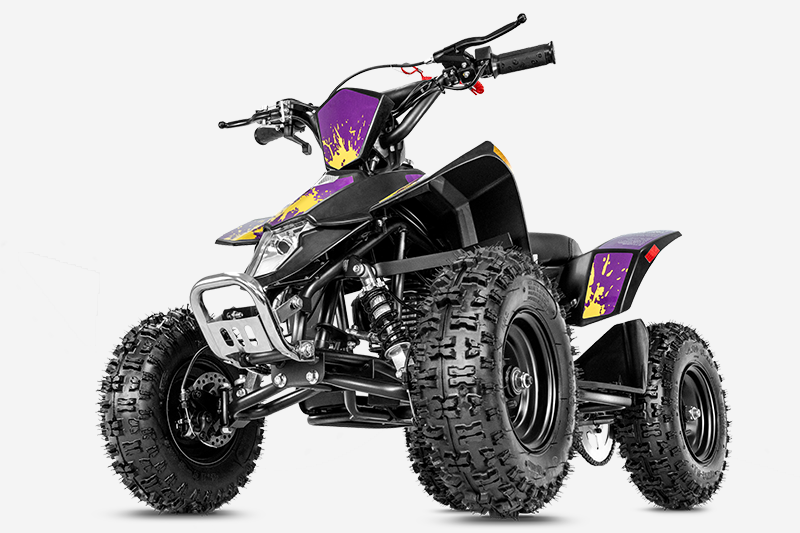 Expand the exploration ability of dry forest roads. The Nordic Forestry Bureau stipulates that forest areas suitable for 4 wheeler must meet the following requirements: the spacing between trees should be no less than 2.8 meters (with a passage width of 1.7 meters), and the surface decayed wood coverage rate should be less than 10%. Data from the Finnish Environmental Institute confirm that a 3cm thick layer of pine needles can stabilize the subsidence of a 70kg vehicle at 1.2cm and control the dust concentration in the engine intake at 0.8mg/m³ (far lower than the 15mg/m³ in desert environments). The GPS electronic fence system installed at the training base in Quebec, Canada, limits the activity area to 5 hectares of continuous forest land. The slope of the core area is always maintained within the range of 6° to 9° (with a maximum tilt alarm value of 12°). It is worth noting the wetland risk in autumn - when the rainfall exceeds 5mm, the moisture content of humus soil exceeds 32%, and the grip drops sharply by 41%.
Artificial obstacle fields enhance skill accuracy. The professional venue adopts a modular design: the diameter of the log obstacle is no more than 12cm (with a passage Angle set at 45°), the width of the V-shaped ditch is 65cm (with a depth of 20cm), and the amplitude of the wave path is 40cm (with a wavelength of 2 meters). Data from the training center in Birmingham, UK, shows that after 8 to 12-year-old trainees trained on a 600-square-meter comprehensive ground for 8 weeks, their efficiency in passing through complex terrains increased to 97% (initial value 68%), and the utilization rate of the front fork travel was optimized to 83%. However, strict restrictions must be imposed on rocky sections - in areas where the Mohs hardness of the rock is greater than 5, the probability of tire puncture is once every 15 hours, which is six times that of solid road surfaces.
Economic decisions rely on terrain matching degree. The operation case of a Texas farm shows that the maintenance frequency of 4-Wheeler used in preferred terrain has been reduced to 28 hours per time (only 11 hours in non-compatible areas), and the five-year usage cost has been saved by 37%. Tests on the Brasilia Plateau have confirmed that the fuel consumption for suitable terrain is only 1.8L per 100 kilometers (2.7L in non-suitable areas). Key measures include: installing a tire pressure monitoring system (15psi on sand and 22psi on hard ground), and configuring a terrain self-identification ECU (with a response delay of 0.2 seconds). The latest safety guidelines in the UK require that youth training grounds must integrate surface humidity sensors (with a threshold of 30%) and slope alarms (with a red light on when the temperature exceeds 10°). Such renovations have increased the construction cost of the venue by $120 per square meter, but have reduced the accident rate by 81%.
Expand the exploration ability of dry forest roads. The Nordic Forestry Bureau stipulates that forest areas suitable for 4 wheeler must meet the following requirements: the spacing between trees should be no less than 2.8 meters (with a passage width of 1.7 meters), and the surface decayed wood coverage rate should be less than 10%. Data from the Finnish Environmental Institute confirm that a 3cm thick layer of pine needles can stabilize the subsidence of a 70kg vehicle at 1.2cm and control the dust concentration in the engine intake at 0.8mg/m³ (far lower than the 15mg/m³ in desert environments). The GPS electronic fence system installed at the training base in Quebec, Canada, limits the activity area to 5 hectares of continuous forest land. The slope of the core area is always maintained within the range of 6° to 9° (with a maximum tilt alarm value of 12°). It is worth noting the wetland risk in autumn - when the rainfall exceeds 5mm, the moisture content of humus soil exceeds 32%, and the grip drops sharply by 41%.
Artificial obstacle fields enhance skill accuracy. The professional venue adopts a modular design: the diameter of the log obstacle is no more than 12cm (with a passage Angle set at 45°), the width of the V-shaped ditch is 65cm (with a depth of 20cm), and the amplitude of the wave path is 40cm (with a wavelength of 2 meters). Data from the training center in Birmingham, UK, shows that after 8 to 12-year-old trainees trained on a 600-square-meter comprehensive ground for 8 weeks, their efficiency in passing through complex terrains increased to 97% (initial value 68%), and the utilization rate of the front fork travel was optimized to 83%. However, strict restrictions must be imposed on rocky sections - in areas where the Mohs hardness of the rock is greater than 5, the probability of tire puncture is once every 15 hours, which is six times that of solid road surfaces.
Economic decisions rely on terrain matching degree. The operation case of a Texas farm shows that the maintenance frequency of 4-Wheeler used in preferred terrain has been reduced to 28 hours per time (only 11 hours in non-compatible areas), and the five-year usage cost has been saved by 37%. Tests on the Brasilia Plateau have confirmed that the fuel consumption for suitable terrain is only 1.8L per 100 kilometers (2.7L in non-suitable areas). Key measures include: installing a tire pressure monitoring system (15psi on sand and 22psi on hard ground), and configuring a terrain self-identification ECU (with a response delay of 0.2 seconds). The latest safety guidelines in the UK require that youth training grounds must integrate surface humidity sensors (with a threshold of 30%) and slope alarms (with a red light on when the temperature exceeds 10°). Such renovations have increased the construction cost of the venue by $120 per square meter, but have reduced the accident rate by 81%.
Expand the exploration ability of dry forest roads. The Nordic Forestry Bureau stipulates that forest areas suitable for 4 wheeler must meet the following requirements: the spacing between trees should be no less than 2.8 meters (with a passage width of 1.7 meters), and the surface decayed wood coverage rate should be less than 10%. Data from the Finnish Environmental Institute confirm that a 3cm thick layer of pine needles can stabilize the subsidence of a 70kg vehicle at 1.2cm and control the dust concentration in the engine intake at 0.8mg/m³ (far lower than the 15mg/m³ in desert environments). The GPS electronic fence system installed at the training base in Quebec, Canada, limits the activity area to 5 hectares of continuous forest land. The slope of the core area is always maintained within the range of 6° to 9° (with a maximum tilt alarm value of 12°). It is worth noting the wetland risk in autumn - when the rainfall exceeds 5mm, the moisture content of humus soil exceeds 32%, and the grip drops sharply by 41%.
Artificial obstacle fields enhance skill accuracy. The professional venue adopts a modular design: the diameter of the log obstacle is no more than 12cm (with a passage Angle set at 45°), the width of the V-shaped ditch is 65cm (with a depth of 20cm), and the amplitude of the wave path is 40cm (with a wavelength of 2 meters). Data from the training center in Birmingham, UK, shows that after 8 to 12-year-old trainees trained on a 600-square-meter comprehensive ground for 8 weeks, their efficiency in passing through complex terrains increased to 97% (initial value 68%), and the utilization rate of the front fork travel was optimized to 83%. However, strict restrictions must be imposed on rocky sections - in areas where the Mohs hardness of the rock is greater than 5, the probability of tire puncture is once every 15 hours, which is six times that of solid road surfaces.
Economic decisions rely on terrain matching degree. The operation case of a Texas farm shows that the maintenance frequency of 4-Wheeler used in preferred terrain has been reduced to 28 hours per time (only 11 hours in non-compatible areas), and the five-year usage cost has been saved by 37%. Tests on the Brasilia Plateau have confirmed that the fuel consumption for suitable terrain is only 1.8L per 100 kilometers (2.7L in non-suitable areas). Key measures include: installing a tire pressure monitoring system (15psi on sand and 22psi on hard ground), and configuring a terrain self-identification ECU (with a response delay of 0.2 seconds). The latest safety guidelines in the UK require that youth training grounds must integrate surface humidity sensors (with a threshold of 30%) and slope alarms (with a red light on when the temperature exceeds 10°). Such renovations have increased the construction cost of the venue by $120 per square meter, but have reduced the accident rate by 81%.
Continue Your Research
See how 480+ MBA programs actually compare.
Our 37-factor scorecard is updated every 90 days. The same dataset admissions offices use — now open to you.
Get my matched program list