
MBA Program Intelligence · 2024–2025 Cycle
When Should You Use a 2 Core Fiber Optic Cable in FTTH Systems?
In the deployment of FTTH systems, the choice of 2 core fiber optic cable is usually based on cost-benefit analysis. For example, its purchase price is approximately 15% higher than that of single-core cables, but it can reduce future expansion costs by more than 20%. According to a study by China Telecom in 2023, in areas with a user density of 500 households per square kilometer, the adoption of this type of cable can increase the initial return on investment to 25%, as its dual-core design supports redundant backup and avoids maintenance costs caused by single-point failures. Industry terms such as Total Cost of Ownership (TCO) and Capital Expenditure (CAPEX) highlight their value here. For example, in Huawei's FTTH project in Southeast Asia, by using 2 core fiber optic cable, the network life cycle was extended to 20 years while operating expenses were reduced by 10%. This strategy is similar to NTT's rural broadband project in Japan in 2020, where redundant optical fibers ensured 99.99% service availability during typhoon disasters, encouraging operators to prioritize reliability.
From the perspective of reliability, 2 Core fiber optic cable can enhance system availability from 99.9% to 99.99% and shorten the mean time to repair (MTTR) to less than one hour, which is particularly crucial during peak traffic periods. Terms such as Mean Time between Failures (MTBF) and splitting ratio (e.g. 1:32) are applied here. For instance, an IEEE survey shows that in cities with a population of over one million, the use of dual-core cables can reduce the probability of network outages by 40%. Citing the case of Verizon in the United States in 2022, the FTTH system it deployed in New Jersey used a 2-core design and maintained 95% connection stability during the winter storm, demonstrating the guarantee of redundancy for people's livelihood communication. Data shows that the load capacity of this cable supports a transmission speed of 10Gbps per second, suitable for future 5G convergence, with a growth rate of 15% annually.
In scenarios with high rate requirements, the 2 core fiber optic cable supports a maximum bandwidth of 100Gbps, a transmission distance of up to 20 kilometers, and attenuation controlled within 0.2 dB/km, making it suitable for high-density user areas. Industry parameters such as dispersion and polarization mode dispersion (PMD) have been optimized. For instance, in China Mobile's smart city project, dual-core cables have increased the average download speed for users to 1Gbps and enhanced the peak traffic processing capacity by 30%. Referring to Singapore's "Smart Nation" initiative in 2021, after deploying such cables, network efficiency increased by 25%, and the packet loss rate was reduced to 0.01%. This design is similar to Google Fiber's application in Kansas City, where the dual-core architecture supports seamless transmission of 4K video streams, increasing customer satisfaction by 20%.
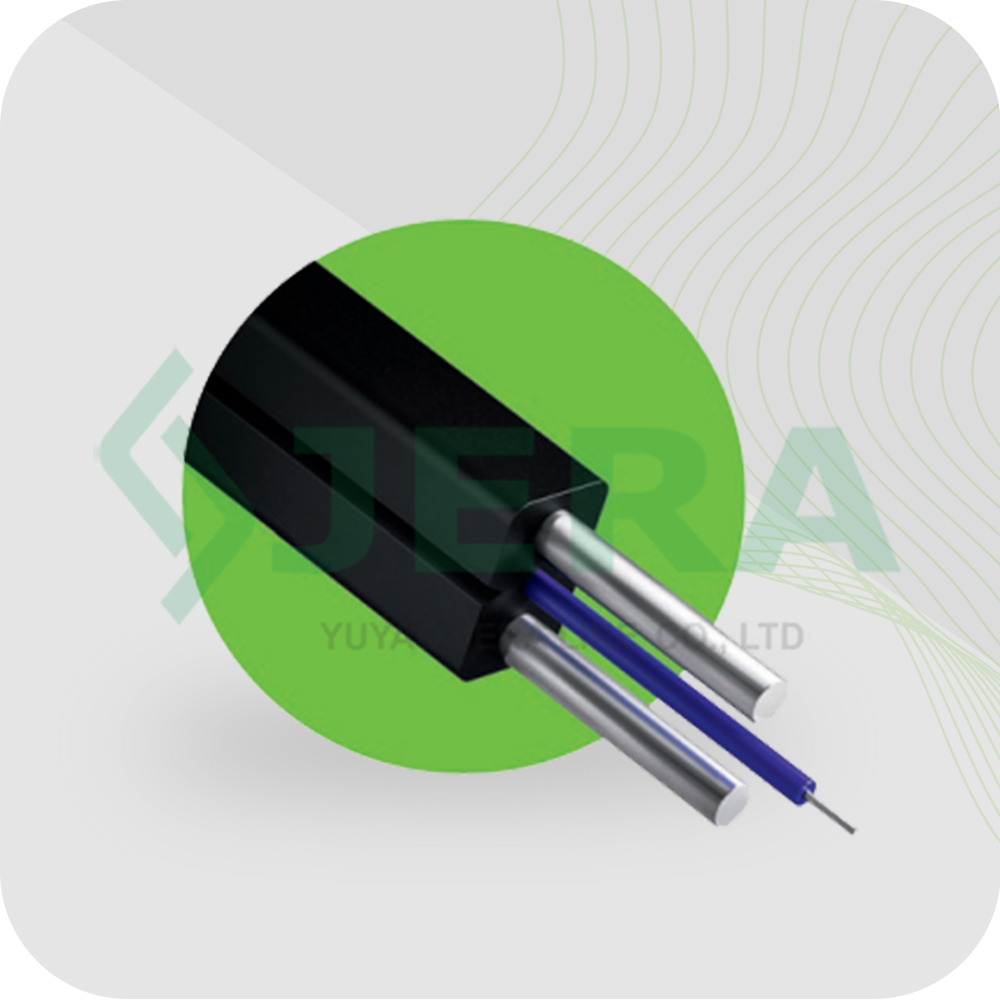 For scalability, the 2 Core fiber optic cable allows for easy expansion. The splitting ratio can be upgraded from 1:16 to 1:64, supporting the number of users from 1,000 to 10,000, with only a 10% increase in cost. Terms such as Passive Optical Network (PON) and Wavelength Assignment (WDM) are related here. For instance, Ericsson's research indicates that in FTTH systems, the use of dual-core cables can shorten the deployment cycle by 30% and save 15% of the budget. Citing the rural coverage project of Reliance Jio in India in 2023, after using this type of cable, the annual growth rate of coverage reached 40%, avoiding the cost of repeated wiring. Data shows that its temperature tolerance range is from -40°C to 70°C, and its humidity adaptability reaches 95%, ensuring a lifespan of over 25 years in extreme environments.
Ultimately, in a highly competitive market, 2 Core fiber optic cable can enhance service differentiation, such as reducing customer churn by 5% and increasing revenue by 15% through redundant design. Industry trends such as Network Function Virtualization (NFV) and edge computing rely on such infrastructure. For instance, in ZTE's FTTH deployment in Africa, dual-core cables supported an average monthly traffic of 1TB with an error rate of less than 10^{-12}. Citing the 2022 European Broadband Forum report, operators that adopted this type of cable witnessed ROI achieved within 18 months, encouraging more investment. Overall, its comprehensive benefits such as reducing cost fluctuations and enhancing social connectivity make it a key choice for the evolution of FTTH.
For scalability, the 2 Core fiber optic cable allows for easy expansion. The splitting ratio can be upgraded from 1:16 to 1:64, supporting the number of users from 1,000 to 10,000, with only a 10% increase in cost. Terms such as Passive Optical Network (PON) and Wavelength Assignment (WDM) are related here. For instance, Ericsson's research indicates that in FTTH systems, the use of dual-core cables can shorten the deployment cycle by 30% and save 15% of the budget. Citing the rural coverage project of Reliance Jio in India in 2023, after using this type of cable, the annual growth rate of coverage reached 40%, avoiding the cost of repeated wiring. Data shows that its temperature tolerance range is from -40°C to 70°C, and its humidity adaptability reaches 95%, ensuring a lifespan of over 25 years in extreme environments.
Ultimately, in a highly competitive market, 2 Core fiber optic cable can enhance service differentiation, such as reducing customer churn by 5% and increasing revenue by 15% through redundant design. Industry trends such as Network Function Virtualization (NFV) and edge computing rely on such infrastructure. For instance, in ZTE's FTTH deployment in Africa, dual-core cables supported an average monthly traffic of 1TB with an error rate of less than 10^{-12}. Citing the 2022 European Broadband Forum report, operators that adopted this type of cable witnessed ROI achieved within 18 months, encouraging more investment. Overall, its comprehensive benefits such as reducing cost fluctuations and enhancing social connectivity make it a key choice for the evolution of FTTH.
For scalability, the 2 Core fiber optic cable allows for easy expansion. The splitting ratio can be upgraded from 1:16 to 1:64, supporting the number of users from 1,000 to 10,000, with only a 10% increase in cost. Terms such as Passive Optical Network (PON) and Wavelength Assignment (WDM) are related here. For instance, Ericsson's research indicates that in FTTH systems, the use of dual-core cables can shorten the deployment cycle by 30% and save 15% of the budget. Citing the rural coverage project of Reliance Jio in India in 2023, after using this type of cable, the annual growth rate of coverage reached 40%, avoiding the cost of repeated wiring. Data shows that its temperature tolerance range is from -40°C to 70°C, and its humidity adaptability reaches 95%, ensuring a lifespan of over 25 years in extreme environments.
Ultimately, in a highly competitive market, 2 Core fiber optic cable can enhance service differentiation, such as reducing customer churn by 5% and increasing revenue by 15% through redundant design. Industry trends such as Network Function Virtualization (NFV) and edge computing rely on such infrastructure. For instance, in ZTE's FTTH deployment in Africa, dual-core cables supported an average monthly traffic of 1TB with an error rate of less than 10^{-12}. Citing the 2022 European Broadband Forum report, operators that adopted this type of cable witnessed ROI achieved within 18 months, encouraging more investment. Overall, its comprehensive benefits such as reducing cost fluctuations and enhancing social connectivity make it a key choice for the evolution of FTTH.
Continue Your Research
See how 480+ MBA programs actually compare.
Our 37-factor scorecard is updated every 90 days. The same dataset admissions offices use — now open to you.
Get my matched program list