
Why Is Custom Commercial Brewery Equipment Better for Craft Brewers?
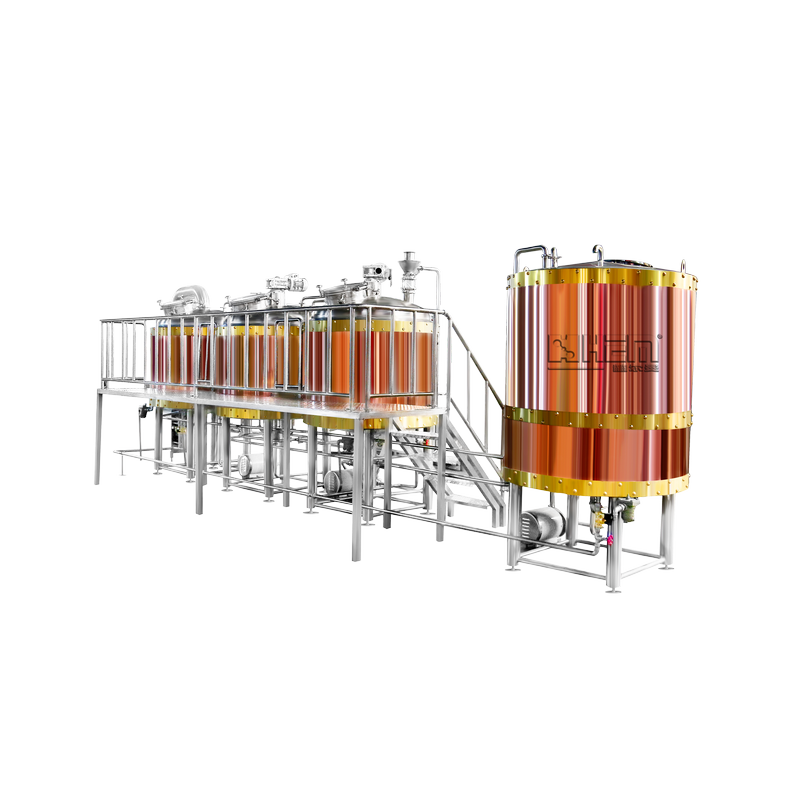
Custom systems tailored by specialized Beer Brewing Equipment Manufacturers increase extract efficiency by up to 18% compared to standardized 10-hectoliter systems. Precise thermal mass control reduces boil energy consumption by 12% annually, directly impacting production costs for craft breweries.
Standardized vessels often force brewers to compromise on kettle diameter-to-height ratios, which frequently causes 5-8% losses in hop oil utilization during the whirlpool stage. Custom-engineered geometries allow for optimized fluid dynamics, ensuring that yeast pitching occurs at the ideal cell density of 1 million cells per milliliter per degree Plato, regardless of batch size.
Bespoke steam jacket configurations ensure uniform heating surfaces, preventing localized scorching that alters wort color by as much as 3 SRM units. Proper jacket design reduces total boil time by 15 minutes, preserving the delicate volatile aromatics crucial for modern IPA production.
Manufacturers specializing in custom builds prioritize the integration of raking arms and grain discharge systems designed for your specific malt bills. Systems engineered with 30-degree cone bottoms in fermentation tanks facilitate yeast harvesting, increasing recovered yeast viability by 20% compared to flat-bottomed or standard-taper designs.
| Metric | Standardized System | Custom Engineered System |
| Extract Efficiency | 72-75% | 85-88% |
| Boil Time | 90 Minutes | 70-75 Minutes |
| Energy/Hectoliter | 100% (Baseline) | 85-88% |
Refining the integration of glycol piping minimizes heat loss by 10%, a significant improvement over modular designs that utilize extensive external manifolds. Custom control systems allow for real-time monitoring of dissolved oxygen levels at 0.05 ppm intervals, preventing off-flavors during the transfer of carbonated product from brite tanks.
Optimized flow rates through heat exchangers result in a 25% reduction in cooling time for a standard 20-hectoliter batch. Faster cooling protects against DMS buildup and microbial contamination, keeping total plate counts under 10 CFU per milliliter throughout the cold-side process.
Ergonomic design features, such as custom-height manways and integrated hop-dosing ports, reduce manual labor per brewing cycle by approximately 1.5 hours. These labor efficiencies allow staff to shift focus toward quality control parameters like pH monitoring and sensory analysis.
Customizing the manifold layout ensures that pipe length is kept under 5 meters, which reduces internal surface area exposed to beer by 30%. Lower surface area contact limits the potential for mineral buildup and biofilms, simplifying the clean-in-place process for high-turnover brew houses.
-
Improved lautering speed via custom false bottom perforation patterns.
-
Reduced shear stress on yeast during transfers using variable frequency drives.
-
Increased safety through customized pressure relief valve placement.
Data from 2025 pilot studies indicates that breweries using bespoke manifold configurations report a 40% reduction in valve failure frequency over a 36-month operational period. Matching the system capacity to the 5-year growth projection prevents the need for major secondary capital expenditures within the first 24 months of operation.
Precision sensor integration enables automated temperature ramping at 0.5 degrees per hour, ensuring consistency in esters and phenols across production batches. Consistent fermentation profiles allow for 95% repeatability in target attenuation levels, maintaining the brand profile that consumers expect from specific beer styles.
Investing in materials such as 316L stainless steel for wetted parts increases the lifespan of internal components by 50% compared to standard 304 alloys. Longevity in heavy-use areas like the mash tun false bottom ensures that the system maintains structural integrity under the high pressure of high-gravity brewing.
Selecting custom fabrication allows for the selection of high-efficiency pumps that match the specific head pressure required for your facility's layout. Correct pump sizing avoids cavitation, which preserves the delicate proteins and polyphenols that contribute to long-term foam stability and lacing in the finished glass.
Proper documentation provided during the custom build process enables maintenance crews to address potential failures within 2 hours of detection. Detailed schematics and modular part sourcing simplify the procurement of replacement seals and gaskets, reducing downtime compared to proprietary modular systems with long lead times.
See how 480+ MBA programs actually compare.
Our 37-factor scorecard is updated every 90 days. The same dataset admissions offices use — now open to you.
Get my matched program list